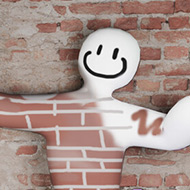
MECCHA CHAMELEON looks like a pastel cartoon made for children: soft colors, cheerful sound design, and stages full of ordinary furniture and toys. What actually happens once a round starts is closer to a quiet stakeout than a kids’ game. One team paints their bodies to disappear into wallpaper, stacked chairs, and hotel lobbies, while the other team walks room to room hunting for the single shape that doesn’t belong. That gap between the cute presentation and the tense, forensic hunt underneath is a big part of why the game became one of the biggest surprise hits of 2026.
Painting a Body Into the Background
The premise splits players into two roles. Hiders start each round with a blank, pale chameleon body and a preparation window to disguise it against the environment. Seekers wait out that window and then search the map before a timer runs out. There is no object-morphing here the way there is in classic prop-hunt games; a hider always keeps a bipedal chameleon shape and has to sell the disguise entirely through paint, pose, and positioning.
The painting toolkit is deep enough that it functions almost like a small art program. Hiders work with a color wheel, RGB and HSV sliders, a stored palette bank for reusing mixed colors, and separate metallic and roughness controls that change how light reflects off the skin. The standout tool is the Spoid, an eyedropper that samples color directly from any surface in the scene, letting a hider match a wall or a stack of chairs pixel-for-pixel rather than guessing at a shade.
None of that painting effort means much without positioning to back it up. A flawless color match on a body standing upright in an open courtyard still reads as a person the instant a seeker walks past. The game rewards treating paint as the last step of a disguise, not the whole of it.
Hiders, Seekers, and the Oni: Three Ways to Play
The searching side is officially called Seekers, though the in-game label reads Oni and plenty of guides just call them Hunters interchangeably. Whatever the name, their job is the same: comb the map before time expires while the larger Hider team stays frozen and disguised. Only the person hosting the lobby chooses which mode a given round uses, and the developers have added new modes and maps at a steady pace since launch.
Three modes currently exist. Each one changes the tension of a round even when it’s played on the exact same map:
- Basic — the standard split between Hiders and Seekers; if even one hider is still undiscovered when the clock hits zero, the whole hider team wins.
- Infection — starts like Basic, but any hider who gets caught immediately switches sides and joins the search, so the seeking team snowballs larger as the round goes on.
- Double — there are no fixed teams at all; everyone hides and paints first, then everyone becomes a seeker simultaneously, and success comes down to who spots the most opponents before time runs out.
Infection in particular changes how hiders should think about risk. A spot that’s safe for the first ninety seconds of a Basic round can become a death trap in Infection once four or five former hiders start actively helping the hunt.
Five Stages Built for MECCHA CHAMELEON’s Hiders
Lobbies are built for small groups, with the game recommending somewhere between two and ten players per match. Five maps currently exist, and each one asks for a different disguise strategy because of how its lighting and clutter are arranged.
- Hide-and-Seek Mansion
- Indoor Countryside
- Sewers
- The Backrooms
- Penguin Hotel
The Backrooms is widely considered the hardest map: its harsh, even fluorescent lighting removes the shadow advantage that hiders rely on elsewhere, leaving only bikes on walls, stacked chairs, and exit signs as cover. Penguin Hotel, the newest addition, takes the opposite approach — its lobby is so packed with props, wood fixtures, and competing color schemes that seekers have too much visual noise to scan efficiently, though sloppy paintwork also stands out harder against its busy backgrounds.
The Spot-Pose-Paint Routine
Guides built around the game tend to boil the hider’s preparation phase down to a three-step job, and it’s a genuinely useful way to think about it: the spot gives a disguise a reason to exist, the pose breaks up the telltale outline of a body, and the paint sells the surface once the first two are already right.
- Pick a spot in visually cluttered or dimly lit areas before doing anything else — an empty corner offers nothing to hide the human silhouette.
- Pose to match a nearby object, curling into a ball near round objects or flattening against a wall, rather than standing straight.
- Paint last, layering the base color with shadows, texture lines, and the correct metallic and roughness values instead of a single flat tone.
Timing matters as much as the steps themselves. Experienced hiders secure their spot within the first third of the preparation window, then spend the rest of it refining pose and paint rather than wandering the map looking for something better.
Mistakes Hiders Make, and How Seekers Exploit Them
A recurring theme across community guides is that new hiders judge their own disguise from the first-person camera, which never shows the gaps and clipping errors a seeker will actually see. Rotating the camera a full circle in third person before the hunt phase begins catches most of these problems early.
- Painting a flat, single color instead of layering shadows and texture.
- Opening the paint menu before choosing a hiding spot, leaving the body exposed mid-round.
- Hiding in obvious corners, which every seeker checks first.
- Ignoring the metallic and roughness sliders, so a perfect color still looks glossy or wrong under the map’s lighting.
- Micro-adjusting position during the hunt phase, since movement is what human vision is built to catch.
Seekers who understand this flip the logic around: the community mantra is that seekers hunt shapes, not colors. Instead of scanning for a specific hue, experienced seekers scan by zones, moving methodically and checking the outline of every prop rather than trusting that a good paint job means a real object.
Patch 1.2.0 and the Spots MECCHA CHAMELEON Players Lost
Live updates have reshaped the map pool since release. Version 1.2.0, released in June 2026, added Penguin Hotel as the fifth map and, at the same time, adjusted The Backrooms specifically to stop hiders from clipping partway into walls.
That second change quietly invalidated a lot of previously popular hiding spots. Pre-patch guide videos showing wall-stuck positions on The Backrooms stopped being reliable overnight, and players who had memorized those spots had to relearn the map from scratch. It’s a small but real friction point in an otherwise well-received game: because MECCHA CHAMELEON keeps tuning its maps, the community’s collective knowledge has a shelf life.
Most players treat this as the cost of playing a game that’s still being actively balanced rather than a lasting complaint, but it’s worth knowing before investing hours into memorizing spot lists that a future patch could quietly delete.
A Breakout Nobody Predicted
The reception numbers are unusually strong for an indie hide-and-seek game. Among 26,130 English-language reviews, 90% are positive, and across all languages combined — 52,697 reviews — the overall rating sits at Very Positive, though the Simplified Chinese client shows a more mixed response by comparison.
Sales estimates from analyst Rhys Elliot put the game at roughly 12.6 million copies sold between its June 2026 release and June 30 of that year, ahead of far bigger multi-platform releases from the same stretch. Elliot summarized it bluntly: it was “the most popular game of the year so far. By some distance, too.”
Short rounds, constant comedic near-misses, and a premise that reads instantly on a stream all help explain why a game about painting yourself into a chair became this large this fast.
How many maps does MECCHA CHAMELEON have?
Five as of the most recent update: Hide-and-Seek Mansion, Indoor Countryside, Sewers, The Backrooms, and Penguin Hotel, the last of which was added in patch 1.2.0.
What’s the real difference between Basic and Infection mode?
Basic keeps two fixed teams for the whole round, so a hider who’s never found simply wins when time runs out. Infection converts caught hiders into seekers on the spot, so the hunting side grows larger and the pressure on remaining hiders escalates as the clock ticks down.
Which tool lets a Hider copy an exact color from the environment?
The Spoid, an eyedropper built into the painting interface that samples color directly from any surface in the scene, including its metallic and roughness properties rather than just its base hue.
Between the five maps, the Spoid’s exact color-matching, and a patch history that keeps rewriting which hiding spots still work, MECCHA CHAMELEON has turned a simple hide-and-seek premise into something with real depth to argue about — which is likely a large part of why it outsold nearly every other release in the first half of 2026.