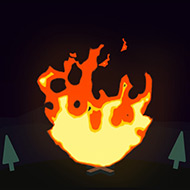
In My Fire Is Bigger Than Yours you start with a single tiny campfire and a pile of wood to throw into it, which matters because everything else in the game — the lightning, the fireworks, the eventual push toward outgrowing the sun itself — only exists because that first small flame survived long enough to be fed. Even at this early demo stage, the loop already has enough moving parts to make each run feel meaningfully different from the last one.
Throwing Things Into a Fire Until It Stops Being Small
The core loop is simple to describe: click and drag items into the fire to make it grow, and use the money that growth generates to unlock more things worth throwing in. Wood is the basic fuel that gets a run started, but the game escalates quickly into more volatile options — lightning-based fuel that adds an electrical element to the fire, and explosives or fireworks that behave very differently once a few upgrades start interacting with them.
That escalation is where the game’s real hook shows up. Chain-reaction upgrades let one item trigger others nearby, so a firework landing in the right spot can set off several more firework spawns in sequence, turning a single toss into a much bigger, messier burst of growth than the same toss would have produced early in a run.
An unlockable flick upgrade changes the core interaction itself, converting the drag-and-drop toss into a flicking motion instead. It’s a small mechanical shift, but it noticeably changes the rhythm of later play once a fire is being fed constantly rather than fed one careful toss at a time.
The Rain That Threatens to Put Everything Out
Fire in this game isn’t just a number that goes up — it’s something that has to be actively protected. Periodic rain storms threaten to extinguish a growing fire, and dealing with them is one of the more strategic layers built on top of the basic throwing loop.
Shield upgrades exist specifically to blunt the damage a storm does, while separate delay upgrades push back when the next storm actually arrives, buying more uninterrupted growth time before the next threat shows up. Balancing investment between raw growth upgrades and this kind of storm protection is where runs start to diverge from each other, since a fire that’s grown fast but skipped shield upgrades entirely can lose a huge amount of progress to a single bad storm.
New players commonly make the mistake of pouring every early upgrade point into fuel and size, only to watch a rain storm undo several minutes of careful growth because no protection was ever purchased. Balancing the two systems, rather than maxing one while ignoring the other, is the lesson most players learn the hard way on their first run.
Three Phases, One Escalating Fire
Players adapt their approach across three separate phases as the fire grows from a small campfire into something the game frames as a celestial-scale force. Strategy in the early phase — where wood and basic fuel dominate — looks nothing like strategy in the later phases, once explosive chain reactions and larger-scale upgrades change what’s actually worth throwing in.
A typical run through the available content takes about half an hour, and the current build focuses specifically on the first of the three escalation arcs, with the more dramatic later growth mechanics reserved for further development.
- What’s the difference between wood and the more advanced fuel types? Wood is the reliable basic fuel that gets a run started, while lightning and explosive fuel types introduce more volatile, chain-reaction-prone behavior once relevant upgrades are unlocked.
- How does the flick upgrade change gameplay? It converts the basic drag-and-toss interaction into a flicking motion, changing the pacing of later play once the fire needs constant feeding rather than occasional careful tosses.
- Why do rain storms matter so much strategically? Because they can extinguish significant fire growth if a player hasn’t invested in shield or delay upgrades, storms force a balance between pure growth spending and protective spending throughout a run.
An Upgrade Tree That Reveals Itself as You Go
Rather than showing every possible upgrade from the start, the tech tree only displays upgrades once they’re actually available, which keeps a player’s attention on what’s immediately useful instead of overwhelming them with a long list of distant, irrelevant options. Costs scale sharply as a run progresses, with some upgrades roughly doubling or tripling in price each time, so later purchases require noticeably more patience than the early, cheap upgrades that get a fire moving in the first place.
A separate heat mechanic is also present in the current build, though it’s noticeably less developed than the fuel and rain systems — player feedback has flagged it as an area still being worked out rather than a fully realized part of the loop, which fits a demo that’s explicitly focused on the first of three planned escalation arcs.
Early Reception to the Demo
The demo has been well received so far, with roughly 95 percent of its early user reviews positive out of 42 reviews at time of writing. The full game is planned for an August 31, 2026 release, with the current no-cost demo build serving as a preview of the early game rather than the complete escalation the finished version is expected to include.
A review count that size means individual pieces of feedback likely carry more visible weight than they would for a larger release, which is typical of a small demo still gathering its first wave of player reactions ahead of a full launch.
Between the rain storms, the chain-reaction fireworks, and a tech tree that only reveals the next step once it’s actually relevant, My Fire Is Bigger Than Yours keeps its pitch simple even as the fire itself stops being simple — throw things in, protect the flame from the rain trying to kill it, and keep escalating until a campfire that started with a single log is chasing something far bigger than it ever looked capable of becoming.