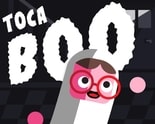
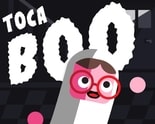
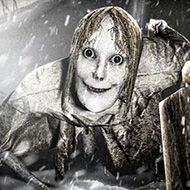
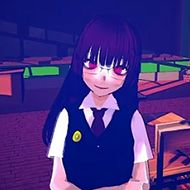
You creep down the hallway with the left mouse button held, easing toward a family that has no idea a ghost is sharing the house with them, and the instant they turn away you let go — the silence that follows is the whole game in one breath. Toca Boo drops you into the role of a small, patient ghost whose only real weapon is timing, not scares stacked on top of scares.
The premise is easy to say and harder to pull off: potential buyers keep walking through the house, and your job is to make them regret it before they can make an offer. Toca Boo never asks you to hurt anyone. It asks you to be unsettling and relentless enough that leaving feels like the only sane choice, and that distinction shapes almost every decision once the front door creaks shut behind the first visitor.
Movement and the Left-Click Rule in Toca Boo
Holding the left mouse button is the entire movement system, and it takes longer to trust than you’d expect. Release too early and you stall in an open room with nowhere to hide. Hold too long and you drift past the doorway you meant to duck into. New players spend their first few rooms just learning how much distance one hold-and-release covers, since the game doesn’t pad the controls with much beyond a P or Esc pause menu.
Once the timing clicks, the ghost stops feeling like a cursor and starts feeling like a presence that glides rather than walks. That’s the quiet trick here: the clunkiness in the first two minutes is the same mechanic that makes the later rooms feel deliberate instead of twitchy. Buyers don’t chase in any traditional sense — they react to what they see and hear.
- Hold to glide: distance depends entirely on how long you keep the button down.
- Release near doorways: stopping short avoids drifting into a buyer’s sightline.
- No stamina bar: the only limit on movement is your own timing.
What Actually Scares a House Buyer in Toca Boo
The scares are small on purpose. A door left ajar, an object out of place, a shape at the edge of a hallway — none of it is loud, and that restraint is what makes it work. Players who go in expecting a jump-scare gallery tend to bounce off the game early, because the pacing rewards patience over spectacle.
A buyer who’s already uneasy needs less to send them running than one who just walked in confident, and that escalation curve is the closest thing the game has to a difficulty setting — it’s built into every room rather than announced anywhere. Community talk around Toca Boo tends to describe rooms as easier or harder based purely on how much cover the layout gives the ghost, even though nothing in the game labels them that way.
Family members react independently of one another, so a hallway that feels clear can still have someone watching from a side room you haven’t checked yet.
Why the Ghost Isn’t the Villain of This Game
What separates Toca Boo from a generic haunted-house game is that the ghost is framed as good-hearted, not cruel. You’re not tormenting people for fun — you’re protecting a home you clearly still consider yours, and the game leans into that melancholy instead of playing it for laughs. It’s a small narrative choice that changes how every scare lands.
Because the ghost never physically touches anyone, every success in Toca Boo comes down to presence and suggestion rather than direct confrontation, and that’s a harder needle to thread in design than it sounds. Some players find the runtime short once they’ve adjusted to the pacing, a fair criticism for a game built around a tight jam window and trimmed down from a longer original idea.
- Learn the layout of a room before committing to cross it.
- Use the family’s own movement as cover rather than fighting it.
How do you move in Toca Boo?
You hold the left mouse button to glide toward wherever you’re aiming, then release it to stop. There’s no separate run or walk key, so pacing comes entirely from how long you hold the button.
Is Toca Boo violent?
No. The ghost scares buyers into leaving rather than harming them, keeping the tone closer to a mischievous haunting than a horror shooter.
How long does a full run of Toca Boo take?
Most players finish in well under an hour, since the game was scoped as a tight, focused project rather than a long-form horror title.
Toca Boo works because it trusts a small idea to carry the whole game: one quiet ghost, one house, and buyers who leave the moment the atmosphere turns against them. Once you’ve learned to read a room the way the ghost does, walking a family out the front door without a single word feels like the best ending Toca Boo has to offer.