You slip through a gap between two ride carts, and the calliope music behind you drops half a step, like something is listening for your footsteps to start again. That’s the rhythm of a run in Wonderland: quiet stretches broken by the sense that Mr. Sun already knows where you’re headed before you do.
| Genre |
Horror / Co-op Escape |
| Platforms |
Roblox — Mobile, PC, Console |
| Players |
Solo or squads up to 5 |
| Developer |
ScaryPlay |
What Mr. Sun Wants From Every Run
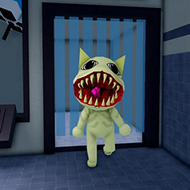
Mr. Sun is the grinning mascot at the center of the park, and he’s the only character the developers have named outright so far. Early on he mostly patrols hallways, and you’ll notice him before you see him — the carnival music warps and the lights start to flicker when he’s close. That warning window is the whole point: react to the audio cue and you get a few extra seconds to reroute before he’s actually in the corridor with you.
By the time you reach the final countdown phase, after all the generator fuses and puzzle gates in a run are cleared, Mr. Sun stops patrolling and starts hunting. He moves faster in this enrage state, and trying to stagger him with a light Hammer swing here doesn’t work the way it did earlier — the smarter move is breaking line of sight around corners rather than standing your ground.
There are other creatures too, mostly corridor patrol types built to corner squads in tight spaces. A well-timed Hammer hit staggers them for about 3 seconds, which is just long enough to slip past through a choke point if your timing is right.
Stamina, Stagger Windows, and the Wonder Shop
Sprinting drains your stamina bar, and it only refills while you’re walking, not standing still. That single rule shapes almost every chase in the game — burn your sprint too early and you’ll be walking, exhausted, right when a creature rounds the corner behind you. Players who treat sprinting like an unlimited resource tend to be the ones who don’t make it to the exit gates.
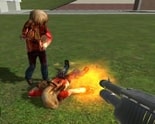
Tickets earned mid-run get spent at the Wonder Shop, which sells a Map (described in-game as “a map drawn by Wander”), a Stopwatch that tracks incoming events, the Hammer, and the Minigun. The Minigun is the loudest option in the shop — its own description calls it “loud, scary, very effective” — and that’s an honest trade-off players argue about constantly: it hits hard, but the noise can pull in creatures you hadn’t noticed yet.
- Map — removes maze dead ends, best for solo runs
- Stopwatch — calls out boss timer windows for a squad
- Hammer — melee stagger option against patrol creatures
- Minigun — heavy ranged damage with a noise penalty
Solo Runs vs Full Lobbies in Wonderland
Wonderland scales cleanly from a quiet solo attempt to a full five-player lobby, and the ideal loadout changes depending on which one you’re running. A solo player leans on the Map and a Wonder Mask to stay hidden through mazes rather than fight. In a full squad, it makes more sense to split roles — someone tracking the Stopwatch, someone else carrying Bandages to keep the group alive, and a frontliner holding the Hammer for hallway encounters.
Newer players tend to treat every run the same regardless of squad size, which is where a lot of runs fall apart. A frontliner build is close to useless when you’re alone, and a pure-stealth Map build wastes a squad’s ability to just fight through trouble instead of avoiding it entirely.
Why Every Wonderland Run Looks Different
Nothing about the layout is fixed. The locations, which monsters spawn, and when events trigger all shift between runs, so memorizing one path through the park won’t carry over to the next attempt — puzzle-solving skill matters more than route memory here, and that’s a deliberate design choice from ScaryPlay, the studio behind The Mimic.
Mini-games gating your progress fall into a handful of types: sequential step-by-step puzzles, multi-switch lever arrays, disorienting mazes, and timed platforming obbies. Some of these double as your only way out of a monster encounter, not just a progress gate, which raises the stakes on puzzles that would otherwise feel like filler.
The randomization is genuinely one of the more divisive design choices among players — some love that no two runs feel scripted, while others find it frustrating that a great run can be undone by an unlucky layout with no safe route to a checkpoint.
How do you beat Mr. Sun in Wonderland?
You generally don’t fight him head-on. Use the light-flicker and audio distortion as your warning, break line of sight around corners once he’s enraged in the final phase, and save Hammer staggers for smaller patrol creatures instead.
What does the Wonder Shop sell?
Confirmed items are the Map, Stopwatch, Hammer, and Minigun, plus support items like Bandages, all bought with Tickets earned by clearing puzzles during a run.
Is Wonderland solo or multiplayer?
Both. You can start a run alone or join a squad of up to five players, and the game supports crossplay across Mobile, PC, and Console.
Wonderland works because it never lets you settle into a routine — one run you’re avoiding Mr. Sun with a Map in hand, the next you’re a frontliner swinging the Hammer through a corridor of patrol creatures, and the park never asks you to solve it the same way twice.