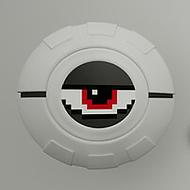
Your Happy Place doesn’t have a single monster chasing you through its halls — the closest thing to a threat is a room full of eyes that seem to notice exactly when you stop moving.
A VHS Camcorder as a Horror Filter
The defining choice in Your Happy Place is presentational: everything is rendered as though it’s being captured on an old camcorder tape, complete with the soft grain, slight motion blur, and washed-out color that anyone who grew up around VHS equipment will recognize instantly. It’s not a gimmick layered on top of a normal game — the filter shapes how you perceive distance, danger, and detail throughout every room.
Because the camcorder aesthetic softens edges and hides detail in shadow, players naturally slow down to look at things twice, which is exactly the pacing the developer, Dark_Knife15, seems to be going for. Reviewers have specifically praised how the visuals turn ordinary exploration into something closer to filming a quiet documentary of an unsettling place.
This is a game built on mood rather than mechanics, and that distinction matters going in — if you’re expecting combat or inventory puzzles as the main draw, Your Happy Place will feel unusually sparse by comparison.
Swimming Pools, Dreamscapes, and the Dark Room
The environments cycle through a handful of distinct settings — swimming pools, dreamlike open spaces, and tighter interior rooms — each carrying its own version of the liminal, half-familiar unease the genre is known for. Community discussion around Your Happy Place frequently returns to one specific dark room where a set of watching eyes appears in the shadows, since it’s the point where several players report first feeling genuinely on edge.
Beginners often try to follow the eyes directly, treating them like an interactive puzzle element, before realizing the room actually wants something closer to patience than pursuit. Once you understand the intended pacing, the sequence flows far more smoothly than it does on a first blind attempt.
Exit signs are scattered through several of these areas, and they function as a quiet design signal that lets you explore fully before committing to move on — a small touch, but one that reviewers have singled out as evidence of careful pacing rather than horror for its own sake.
Small Puzzles Without Hand-Holding
- Puzzle solutions in Your Happy Place are rarely spelled out, but they’re solvable through exploration alone if you pay attention to environmental cues.
- Some rooms gate progress behind noticing a detail that looks like set dressing at first glance.
- Nothing requires a walkthrough to solve fairly, though a handful of sequences trip up players moving too quickly through a space.
Dreamcore fans tend to enjoy this style of puzzle design specifically because it never breaks the atmosphere to explain itself, while more traditional horror-game players sometimes find the ambiguity frustrating if they’re used to clearer objective markers.
Built on Unreal Engine 5, But Not Demanding Top Hardware
Your Happy Place runs on Unreal Engine 5 using the Lumen lighting system and Virtual Shadow Maps, though notably without Nanite geometry — a decision that keeps the game running acceptably on mid-to-high-end machines without requiring a dedicated ray-tracing GPU. It’s a practical choice for a solo-developed project, and it shows in how consistently smooth the experience runs across different reviewer setups.
The project itself has a long history behind that polish. It began as a prototype roughly three years before release, sitting through occasional bursts of development, before Dark_Knife15 finally completed it during the Liminal Game Jam 2026 over about two months of focused work.
What Streamers and Players Keep Saying About Your Happy Place
One recurring piece of feedback is the absence of a flashlight, which some players find genuinely limiting in the darkest sections, arguing it makes navigation harder than the atmosphere strictly requires. It’s a fair critique, and one of the few consistent complaints amid otherwise strongly positive reception.
On the other end of the spectrum, horror content creators have gravitated toward Your Happy Place specifically because its slow-burn tone leaves room for commentary — one popular format involves a deadpan, sarcastic first-person playthrough that plays the dread completely straight against a very different narration style, and that contrast has become part of how the game circulates online.
Atmosphere-focused players and jump-scare fans end up with fairly different takeaways here, since Your Happy Place leans almost entirely on the former rather than the latter.
Is there a flashlight in Your Happy Place?
No — the game deliberately withholds one, which is part of why the darkest rooms, including the section with the watching eyes, feel as disorienting as they do. It’s a common request in player feedback, but not something the current release includes.
How long does it take to finish Your Happy Place?
Playthroughs generally run on the shorter side, closer to a single focused sitting than a multi-hour horror campaign, though players who linger in the swimming pool and dreamscape areas to soak in the VHS visuals naturally take longer.
What makes Your Happy Place different from other backrooms-style games?
The camcorder filter is the biggest differentiator — most liminal-space games go for clean, sterile visuals, while Your Happy Place intentionally degrades its own image quality to create a found-footage feeling that changes how threatening even empty rooms can seem.
Whatever your happy place is supposed to look like, Dark_Knife15’s version of it — swimming pools, watching eyes, and all — makes a strong case that the scariest thing in Your Happy Place isn’t what’s hiding in a room, but how long the camcorder makes you sit there looking for it.