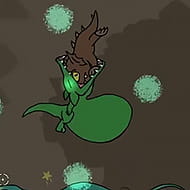
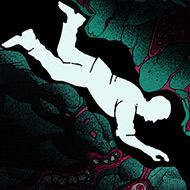
Kobayakawa-san Is a Soulslike looks like a five-minute dating sim but plays like a boss fight where every wrong word ends the run instantly. You were caught spending time with another girl. Kobayakawa-san has found out. She transforms into the Twilight Inquisitor, and now the only tools available to you are Light Attack, Heavy Attack, Parry, and Dodge. There is no charm stat, no dialogue tree, no slowly building affection meter. There is only the correct answer and the death screen.
How Kobayakawa-san Is a Soulslike Actually Works
Each line Kobayakawa-san delivers functions the way an enemy telegraph does in an action RPG. You read the situation, pick a response from the four options, and find out immediately whether you survived or not. A wrong choice triggers an instant death message — the same kind of hard cut that soulslike games use after a boss one-shots you — and you return to exactly the line that killed you rather than restarting from the beginning. That single design decision is the reason most players describe finishing the game in one sitting. The retry cost is almost nothing, which keeps you in the loop rather than pushing you away after failure.
The four response types are not arbitrary. Light Attack and Heavy Attack broadly map to direct confrontational answers, while Parry and Dodge suggest deflection and avoidance. Reading which type fits a given line from Kobayakawa-san is the actual skill of the game. Players who come in expecting the most apologetic-sounding option to be correct get punished consistently. The game is specifically designed to reward players who understand soulslike logic — reading the attack, not the apparent emotional temperature of the moment.
One exchange near the midpoint of the game has become the most discussed moment in every post-release community thread. Players who treat it like a standard romantic confrontation choose Dodge. Players who apply soulslike instinct choose Parry. The difference between those two choices is the entire joke the game is making. Once you get it wrong once, your approach to every remaining line shifts.
Difficulty, Health Bars, and the Twilight Inquisitor
Kobayakawa-san’s health bar must be reduced to zero across three separate confrontation phases. Each phase escalates slightly in tone, and the correct answers in Phase 3 are less intuitive than the earlier exchanges. Players who roll-spam — a habit imported directly from soulslike muscle memory — fail more often in Phase 3 than anywhere else, because Dodge is the least correct answer in the game’s final moments. The community picked up on this immediately after the English release and discussed it at length.
The Twilight Inquisitor transformation is not cosmetic. Once Kobayakawa-san shifts form, the pacing of her lines accelerates. Each question carries a short timer, and letting it run out counts as the wrong answer. This is the detail that separates Kobayakawa-san Is a Soulslike from a simple visual novel with combat framing — the time pressure is real, and it creates the same muscle-tightening urgency that genuine soulslike boss phases produce.
Kobayakawa-san Is a Soulslike and What Players Are Saying
The honest conversation around Kobayakawa-san Is a Soulslike is that it is a five-minute game built on one joke, and how much you get from it depends entirely on how far that joke lands. Players who know soulslike conventions find it sharp. Players who don’t have that context find it cute and slightly confusing. The game does not pretend to be anything more than what it is, and that clarity is actually part of why it spread so quickly after the English release on August 8, 2026.
Players debate whether the trial-and-error structure is genuinely skill-based or just pattern memorization. The counterargument from the community is that most soulslike encounters at their core are pattern memorization under pressure — which is exactly the point Kobayakawa-san Is a Soulslike is making. Whether that argument satisfies you depends on what you wanted from the game.
FAQ
What is the correct strategy for Phase 3 of the Twilight Inquisitor?
Phase 3 punishes Dodge more than any other phase. The correct answer in the final confrontation leans toward Parry for the loaded emotional questions and Light Attack for the more direct accusations. Players who carry Dodge as a default from soulslike habit will fail Phase 3 more than earlier sections. The time limit on Phase 3 responses is also shorter, so the instinct to overthink costs as much as choosing wrong.
How long does it take to finish Kobayakawa-san Is a Soulslike?
The developer estimates around five minutes for a complete run once you know the correct answers. First-time players typically take longer depending on how many deaths accumulate before the pattern clicks. Because the retry point is always the exact line that killed you, the total session time rarely exceeds fifteen to twenty minutes even for players who fail several times per phase.
Is there more than one ending in Kobayakawa-san Is a Soulslike?
The game’s structure is built around finding the single correct path through the Twilight Inquisitor’s three phases rather than branching toward multiple outcomes. There is one successful ending reached by surviving all three phases of Kobayakawa-san’s confrontation without dying — or more precisely, by surviving after however many deaths it takes to learn the pattern. What that ending contains is brief, in keeping with the game’s runtime, and rewards the soulslike read more than a conventional romantic resolution would.
Kobayakawa-san Is a Soulslike works because it commits completely to its premise. Every mechanic — the four response types, the Twilight Inquisitor’s escalating phases, the short timer that cuts off hesitation — comes from the same joke, and the joke holds for exactly as long as the game runs. Players who expect the Parry option to feel comfortable will find that the design specifically resists that comfort, which is the most accurate soulslike thing about it.