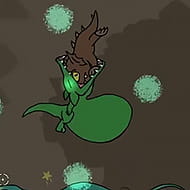
Monster Nomster puts you underground with one simple reversal built into everything: you are the creature that eats. Playing as one of the dragon Mistress’s small servants, you fight through zones of enemies who all want to swallow you first — and the goal is to swallow them back. That core tension, predator or prey depending on who acts first, is what the whole game is built around, and it stays strange enough to be genuinely memorable even in early runs.
| Genre |
Vore-like action shooter |
| Platforms |
Windows, macOS, Linux |
| Protagonist |
Kram |
| Key Zones |
Zone 1, Zone 2, Fungal Forest |
| Status |
Early access / in development |
Kram’s Core Loop and What Actually Kills You
You control Kram, a small draconic servant whose primary win condition is surviving long enough to knock out enemies and then eat them before they recover. The dodge roll is your most critical tool, not your weapons. New players who spend the first hour of the game focused on which breath weapon to equip tend to die far more than players who drill their dodge timing first. Every weapon in Monster Nomster — the Mist Ball, the Blizzard Blower, the Sundering Sun — is genuinely useful, but none of them keep you alive if your roll is off.
Early in the game, Zone 1 enemies are slow enough that you can afford sloppy positioning. The problem is that Zone 1 trains the wrong habits. By the time you reach Zone 2, the wolf-type enemies hit fast and attack in groups, and the underground worm variants burst from the floor with almost no warning. The community consensus on Zone 2 is clear and honest: it’s where most casual players bounce off the game. The jump in density and speed is large enough that players who found Zone 1 comfortable are often shocked.
One specific moment you notice when playing is the sound cue just before a worm surfaces. There is a brief rumble that, once you’ve heard it fail you a dozen times, starts to feel like a reflex trigger. Veterans describe their dodge reaction to that sound as automatic after enough deaths. That kind of sensory conditioning is precisely what Monster Nomster is going for, and it works better in practice than it sounds in a description.
Visitors, Digestion, and the XP System
Between combat rooms, Monster Nomster introduces visitor characters — named characters like Oenla and Peliptor who offer encounters distinct from standard enemy fights. These characters mention reforming after being eaten, which opens up repeated interactions across runs and adds a small but noticeable layer to what would otherwise be a pure combat loop. Players who rush past visitor dialogue early on often miss story context that explains why certain mechanics exist.
Digestion is the healing mechanic, and difficulty mode changes how much it restores. On Easy, a successful eat restores a full health point. On Hard, Hard mode bosses carry 40 percent more health, and the XP curve is deliberately steeper to offset the higher enemy count. Players going for their first Hard clear often underestimate how many more runs it takes to reach a useful level. The level cap sits at 11 in the current build, which the community notes feels tight against late zone enemies.
Dragon eggs function as breath weapon pickups. When you already have four breath weapons equipped, eating an egg gives you the option to swap one out, which is one of the few moments where Monster Nomster demands an active build decision under pressure. The Spectral Tailswipe, which deals 33 percent increased damage after a recent update, has become a popular secondary choice for players who focus on melee spacing rather than projectile spam.
Monster Nomster and Its Honest Roughness
The most divisive topic in the Monster Nomster community is difficulty pacing between zones. Zone 2’s spike is frequently called unpolished rather than intentional, and players debate whether the wolf speed and worm frequency represent a design choice or a difficulty tuning issue that hasn’t been resolved yet. The developer has acknowledged that balance is difficult, which is a fair answer for a solo-developed early access title, but it doesn’t stop the friction from being real for players trying to push past Zone 2 without grinding.
Save file instability has also come up repeatedly in community reports. Some players lose progress on crash or forced quit, which stings more in a game where leveling up across multiple runs is how you grow. For players who commit to Monster Nomster across longer sessions, this is one of the clearest pain points the game currently has.
FAQ
What is the best weapon in Monster Nomster for Zone 2?
The Mist Ball is the community’s most cited Zone 2 choice because its projectile travels through enemies and can stagger groups, which is where Zone 2 punishes you the hardest. The Blizzard Blower is also strong because it chills non-boss enemies and slows their movement, which gives you windows to eat stunned targets safely. Most experienced players carry one area-control weapon and one faster single-target option to swap between.
Do visitor characters like Peliptor appear in every run?
Visitor encounters are not guaranteed in every run, and their placement in combat rooms varies. Peliptor and Oenla are the two visitors confirmed to reference reforming after being eaten, meaning their encounters can repeat across multiple runs without the narrative breaking. If you miss a visitor in one session, returning in a later run will usually surface them again, though exact room placement is not fixed.
Why does Monster Nomster have a level cap of 11?
The current level cap of 11 is a development placeholder that the notes suggest will increase as more zones are added. At cap, perk selection from the leveling system becomes your primary build tool rather than raw stat growth. Players who hit 11 early in a Hard run often find the remaining difficulty comes entirely from movement discipline and weapon timing rather than any further character scaling.
Monster Nomster is still rough in places — the Zone 2 pacing debate is real, and save reliability needs work — but the core loop of reading enemies, timing Kram’s dodge, and landing an eat after a clean knockout has a satisfying rhythm that most action shooter games built around simpler win conditions don’t deliver. The Fungal Forest update added meaningful new content, and the breath weapon swap mechanic shows that the design is growing in smarter directions than early builds suggested.