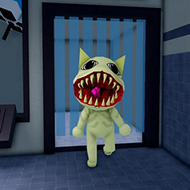
You round a corner in Nextbot Graveyard and the hallway ahead is already gone, replaced by a shape you recognize a half-second too late: Obunga, closing the gap with that low, mechanical growl bouncing off concrete walls. You don’t stop to think. You cut left, clip past a stack of debris, and keep moving, because standing still is the fastest way to end a run before it starts.
| Genre |
Chase and escape horror |
| Objective |
Survive each stage and reach the exit before time runs out |
| Stages |
Six escalating levels |
| Round Timer |
100 seconds per stage |
| Controls |
WASD movement, mouse for looking and interacting |
Inside the Nextbot Graveyard’s Six Stages
Nextbot Graveyard is built around a simple, brutal loop: you’re dropped into a level, given 100 seconds, and told to find the way out before whatever is hunting you closes the distance. Each of the six stages reuses the same core rhythm but changes the layout enough that memorized routes from an earlier run stop working. Early on, the pursuit feels almost fair, with wide corridors and multiple paths to break line of sight.
By the third stage, the map narrows. Dead ends start appearing where you don’t expect them, and the level design stops giving you a second route when your first guess is wrong. This is where most new players get caught, not because the chaser is suddenly faster, but because hesitation gets punished harder than speed does.
The final stages compress everything that came before into tighter spaces with less room to juke. Reaching stage six without a death on your record is something players talk about specifically, because it means you’ve learned every blind corner, not just the first few.
Obunga, Sanic, and the Rest of Nextbot Graveyard’s Chase Roster
The enemies aren’t interchangeable reskins. Obunga is slow to commit but relentless once he locks onto your position, while Sanic covers ground fast enough that a single wrong turn near him ends the round instantly. SpongeBob and Idiot are the ones newer players underestimate, since their patrol patterns look sloppy until they suddenly aren’t.
Then there’s The Preacher, the encounter people bring up most in comments and forum threads. His pacing is deliberately uneven, slow enough to lull you into walking instead of sprinting, then fast enough in short bursts to punish exactly that decision. Players who’ve cleared every stage still admit The Preacher catches them cold on a run they thought was going fine.
Speedrun-minded players treat the roster differently than someone playing for atmosphere, memorizing spawn tendencies to shave seconds off a clear rather than slowing down to watch each animation. That difference in approach is also where the roster gets debated, since some think the jump in aggression between the mid-game and The Preacher is too steep for a fair curve.
Reading the Countdown Before It Reads You
The 100-second timer is the second threat in every stage, and it’s easy to forget about it while you’re focused on not getting caught. Once you reach a stage’s midpoint, the smart move is committing to a direction rather than doubling back to check a room you already cleared.
- Treat the first ten seconds of a stage as scouting time, not sprinting time.
- Break line of sight around corners rather than running in straight lines the chaser can predict.
- Save open sprints for moments when you can see the exit or a clear gap.
Beginners consistently waste the opening seconds standing still, trying to get their bearings, and that habit turns an easy stage into a near-miss. Veteran players call this reading the room before the chase starts, since the exit is often visible if you stop panicking long enough to look.
Player Questions
Why does hiding behind debris sometimes fail against Obunga?
Obunga’s detection isn’t purely visual; once he’s locked onto your last known position, ducking behind cover only helps if you break sightline before he commits to that spot. Hiding too late just delays the catch by a second or two.
Is there a reliable way to survive The Preacher’s speed bursts?
Most players who consistently get past him say the trick is never fully sprinting until his pacing shifts, since committing early leaves no reserve speed for the burst that follows.
Do the six stages get reused or reshuffled between runs?
The stage order stays fixed, but enemy timing within each one varies enough that a route which worked cleanly on one attempt can put you face to face with Sanic on the next.
Nextbot Graveyard rewards the kind of player who treats every hallway as a decision rather than a straight line, and punishes anyone who forgets that Obunga, Sanic, and The Preacher aren’t playing by the same rhythm. Get through all six stages without memorizing every corner first, and you’ll understand why people keep coming back to it.