Tapping Emily does nothing in Brain Test 2: Tricky Stories. The very first level hands players a sleeping farm girl and an instruction to wake her up, and the actual solution is to drag the sun above the mountain until the rooster crows — only then does swiping her window open finish the job. That’s the whole game in miniature: the obvious action is almost never the one that works.
Released in 2020 as a sequel to the original Brain Test, Brain Test 2: Tricky Stories keeps the same trick-question backbone but restructures it around named story chapters instead of one long unbroken level list, giving every puzzle a character and a running situation to sit inside instead of floating on its own.
Emily’s Farm and Brain Test 2’s Idea of Logic
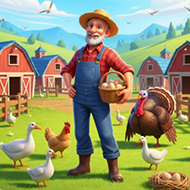
Emily’s Farm is the opening chapter, and its 21 levels set the tone for everything that follows. The instructions describe a normal task — feed an animal, fix a fence, wake someone up — and the actual solution usually comes from touching something the text never mentioned at all.
That wake-up puzzle in level 1 is the clearest example: the stated goal is “wake her up,” but the working solution routes through the sun and the rooster rather than through Emily herself. It’s a small puzzle, but it teaches the exact habit the rest of the game depends on — read the scene, not just the sentence.
The common mistake newer players make is treating the instruction as literal and tapping the named subject over and over, which the level is specifically designed to make fail. Once that habit breaks, later levels in Emily’s Farm and beyond get noticeably faster to solve, even though the puzzles themselves keep getting stranger.
Tom’s Adventure and the Slow Turn Toward the Lion King
Tom’s Adventure opens gently: level 1 just asks players to get friendly with Tom, solved by rubbing his head until he smiles. It’s a low-stakes introduction for a chapter that spans 26 levels and eventually turns into something closer to an action story, as Tom’s situation escalates toward a confrontation with the Lion King later on.
By level 20, the tone has shifted enough that the puzzle itself is framed around the lions chasing Tom, a far cry from the gentle head-scratching of level 1. That escalation across a single chapter is typical of how Brain Test 2 paces its longer chapters: early levels train a mechanic, later levels put it under pressure.
Players who breeze through the first handful of levels in Tom’s Adventure often get caught off guard once the lion storyline kicks in, since the puzzles stop being about simple taps and drags and start requiring attention to threats moving around the scene in real time.
Twenty-One Adventures, One Returning Cast
Beyond Emily’s Farm and Tom’s Adventure, the game spreads its puzzles across more than twenty separate chapters, each built around its own character and premise: the McBrain Family, Monster Hunter Joe, Agent Smith, Bad Luck Betty, Prison Escape, Fitness with Cindy, Captain Mary, and Crazy High School among them. Most chapters run about 20 levels, which puts the total level count well into the hundreds once every chapter is added up.
The chapter format means a player rarely spends more than twenty or so levels with any one set of jokes before moving to a completely different scenario, which keeps the trick-question formula from going stale the way a single unbroken list of levels might. Bad Luck Betty leans on slapstick misfortune, Agent Smith plays with spy-movie tropes, and Monster Hunter Joe turns the same tap-and-drag logic into something closer to a creature feature.
It also means the humor is doing a lot of the work. The puzzles themselves are still built on the same lateral-thinking logic as the original Brain Test, but wrapping them in a specific character’s situation gives every solution a small punchline instead of just a checkmark.
Smith and Joe: When Two Chapters Refuse to Stay Separate
Later on, the Agent Smith and Monster Hunter Joe storylines stop running in parallel and start sharing chapters outright, in entries named Smith and Joe. The crossover continues across at least two parts, and eventually escalates into a chapter pitting the pair against a character called Professor Bigbrain.
This kind of continuity is a real departure from how the original Brain Test worked, where levels were largely self-contained. Here, a joke or a character trait introduced in one chapter can resurface levels later in a completely different one, which rewards players who’ve actually played through the earlier chapters rather than jumping around at random.
It’s a small thing, but it’s the detail longtime players bring up when asked what makes the sequel feel different — not harder puzzles necessarily, just puzzles that remember what happened in the chapter before them.
How Brain Test 2: Tricky Stories Escalates Without Ever Raising the Numbers
There’s no numbered difficulty setting anywhere in the game, and no score to chase. Difficulty instead comes from how far into a chapter a player has gotten and how much the game has trained them to distrust the literal instructions by that point.
Environmental logic is the loose term players use for solutions that ignore the stated goal entirely and manipulate something in the background instead — dragging a sun, shaking an object that was never named, tilting an element of the scene that looks like decoration.
Story continuity is the newer wrinkle the sequel adds on top of that: characters and situations carry over between chapters, most visibly whenever the Smith and Joe storylines intersect, so paying attention to earlier chapters occasionally pays off later.
Together, those two habits are most of what separates a frustrated first attempt at a level from a five-second solve on a second try. Nothing in the interface tells a player which habit a given level wants — that’s still entirely trial and error, and the game is fairly open about not apologizing for it.
What Actually Separates Brain Test 2: Tricky Stories From the Original Brain Test
The original Brain Test built its reputation on a single long run of standalone trick questions, each one a self-contained joke with no real narrative connecting them. Brain Test 2: Tricky Stories keeps that same outside-the-box puzzle logic but organizes it into the twenty-plus named adventures described above, giving every stretch of levels a character, a setting, and a reason to keep going beyond just wanting the next joke.
That structural change is also why comparisons between the two games tend to focus on scope rather than difficulty. The core puzzle-solving skill — ignoring the obvious reading of an instruction — hasn’t really changed between the original and the sequel. What’s different is that the sequel spreads that skill across recurring characters like Cindy, Betty, and the McBrain family, instead of asking players to solve a few hundred completely unrelated one-off jokes in a row.
Whether that’s an improvement is genuinely split among players. Some prefer the tighter, standalone jokes of the original; others find the chapter structure gives the puzzles more reason to exist beyond the gag itself, since a running story gives even a frustrating level some context.
Quick Answers About Brain Test 2
- How many levels are in Brain Test 2: Tricky Stories? The game spreads its puzzles across more than twenty adventures, most running around 20 levels each, which adds up to several hundred levels in total.
- Is Brain Test 2 harder than the original Brain Test? Not really harder so much as longer and more structured — the same lateral-thinking logic applies, just spread across named chapters instead of one continuous list.
- What’s the trick to Emily’s Farm level 1? Dragging the sun up above the mountain triggers the rooster’s crow, and swiping Emily’s window open afterward is what actually wakes her — tapping her directly does nothing.
- Do the Tom’s Adventure and Agent Smith chapters connect to anything else? Yes — Tom’s Adventure builds toward a Lion King confrontation later in its level range, and separate Smith and Joe chapters merge the Agent Smith and Monster Hunter Joe storylines into shared levels.
Brain Test 2: Tricky Stories never really abandons the joke-a-level spirit of the original Brain Test — it just gives that joke a name, a chapter, and occasionally a grudge that carries over from Emily’s Farm all the way to whatever Smith and Joe are dealing with by the time their stories collide. That’s still the whole appeal: a scene that looks ordinary right up until the sun needs dragging across the sky.