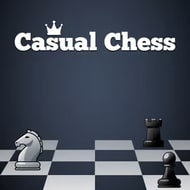
Casual Chess looks like a five-minute distraction dressed up in soft colors, but it plays like a full chess match where a single hanging piece still decides the outcome. The word “casual” describes the presentation — the themes, the low-pressure framing, the option to just sit down with a friend — not the ruleset underneath it. Once two players, or a player and the built-in AI, start a game, every rule that governs a serious game of chess applies here too: the king still has to be protected, a fork still wins material, and checkmate still ends everything.
A Familiar Board With Real Stakes Behind It
The setup is the one anyone who’s touched a chessboard already knows: sixty-four squares, two colors, thirty-two pieces split evenly between two sides. Casual Chess doesn’t reinvent any of that. What it changes is how you interact with it — tap or click a piece to select it, then tap an empty square to move it there, with no drag-and-drop fumbling required.
That simplicity is exactly why the game gets recommended to people easing back into chess after years away. There’s no clock forcing a decision and no rating hanging over the result, but the rules underneath don’t bend just because the mood is relaxed.
Where Casual Chess earns its board-game framing is in how faithfully it treats the objective. You’re not collecting points or racing a timer — you’re trying to trap an enemy king with no legal escape, the same way the game has worked for centuries.
Six Piece Types, Thirty-Two Positions to Manage
Every side fields the same six roles, and each one moves the way it always has, regardless of which theme is applied to the board:
- Pawn — moves forward one square (two on its first move) and captures diagonally, the only piece that captures differently than it moves.
- Knight — jumps in an L-shape and is the only piece that can leap over others.
- Bishop — glides diagonally for as many open squares as it likes, locked to one color for the whole game.
- Rook — moves in straight lines along ranks and files, and becomes especially dangerous on open files.
- Queen — combines the rook’s and bishop’s movement, making it the most valuable piece on the board after the king.
- King — moves one square in any direction and must never be left where it can be captured next turn.
Newer players tend to lean on the queen early because it looks like the strongest piece, then lose it to a cheap pawn or knight attack because it wandered out unsupported. That single habit shows up constantly at every skill level, not just here.
Three Difficulty Settings and What Actually Changes
Casual Chess ships with three difficulty tiers for its computer opponent, letting the same board scale from a forgiving practice partner to something that punishes careless piece placement fast. On the lower setting, the AI tends to miss tactics and trade pieces without much of a plan, which suits players who just want to see legal moves play out without getting punished for every slip.
On the higher setting, the computer stops handing over material for nothing and starts contesting the center and looking for forks. Players who jump straight to the hardest tier without knowing basic opening principles usually notice the difference within the first ten moves.
A hint system sits alongside the difficulty options, offering a suggested move when a player is stuck. It’s a useful crutch for someone relearning the game, though leaning on it every turn tends to stall improvement — the hint solves the position in front of you, not the pattern recognition that would let you solve the next one yourself.
Tactics Casual Chess Players Actually Talk About
Tactical discussion in any chess community almost always circles back to the same three motifs. They’re worth knowing by name because the built-in AI, even on its easier settings, creates the same patterns a human opponent would.
Fork is when one piece attacks two targets at once. A knight landing on a square that threatens both a rook and the king is the textbook version, and it’s usually how casual games swing in someone’s favor.
Pin is when a piece can’t move without exposing something more valuable behind it, most often the king. A pinned piece is effectively frozen for as long as the pin holds, which makes it a safe target for a second attacker.
Skewer is the mirror image of a pin. A valuable piece is attacked directly, forced to move, and whatever sits behind it — often a rook or bishop — gets captured instead.
Recognizing these patterns matters more than memorizing their names. Spotting a fork before it happens, not after, is the actual skill being tested every time a knight lands near the center of the board.
Opening Habits That Decide Casual Chess Matches Early
Games at this level are usually won or lost long before checkmate is even a visible possibility. Control the center, develop knights and bishops before pushing pawns further than necessary, and get the king to safety early rather than leaving it in the middle exposed — these three habits cover most of what separates a competent opening from a shaky one.
Common beginner mistakes repeat themselves constantly: moving the same piece twice in the opening while ignoring development, pushing too many pawns and weakening the squares around the king, and chasing a single tactic while ignoring what the opponent’s last move actually threatened.
None of these mistakes are unique to this board. They’re the same errors chess players have been coached out of for generations, which is part of why the practice transfers directly to a physical set.
Checkmate, Stalemate, and the Endings That Actually Occur
Not every game ends the way players expect. A few distinct outcomes are worth telling apart:
- Checkmate — the king is under attack with no legal move that removes the threat, and the game ends immediately in favor of the attacker.
- Stalemate — the player to move has no legal move at all, but their king isn’t in check; the result is a draw, not a loss, and it catches overconfident players off guard when they’re up material.
- Draw by insufficient material or repetition — when neither side has enough pieces left to force checkmate, or the same position repeats, the game ends without a winner.
Stalemate in particular trips people up. It’s common to see a player with an overwhelming material advantage carelessly trap the opponent’s king with no legal moves, turning a near-certain win into a draw. Understanding the difference between check, checkmate, and stalemate is one of the first real milestones in getting better.
Themes and Hints: The Small Adjustments That Change the Feel
Casual Chess offers three visual themes for the board and pieces, which don’t change any rule but do change how easy it is to read a position at a glance — some players find high-contrast sets easier to scan for hanging pieces than more decorative ones.
The multiplayer option, where two people share a device and take turns, is worth calling out separately from the AI matches. It strips away the difficulty tuning entirely and leaves two players and a board, closer to how most people actually learned chess in the first place.
Between the themes, the hint button, and the three-tier AI, the customization is modest but purposeful. Nothing here changes the actual game of chess being played; it just changes who’s comfortable sitting down to it.
How many difficulty levels does Casual Chess have?
Three. They scale from an AI that trades pieces loosely and misses tactics, to one that contests the center and punishes hanging pieces without much delay.
Does Casual Chess support two-player games against a friend?
Yes. Alongside the AI matches, there’s a mode built for two people to share a board and take turns on the same device, with none of the difficulty settings involved.
What does the hint button actually do in Casual Chess?
It suggests a move for the position currently on the board. It’s useful for players relearning the rules, but relying on it constantly tends to short-circuit the pattern recognition that separates a strong player from one who’s just following suggestions.
Casual Chess earns its name from the mood, not the ruleset — set up a fork with a stray knight, misjudge the difficulty slider, and you’ll still get checkmated by the same rules that have decided real chess games for centuries.