In Feed The Pit you start with a hand of cards and no idea who you are hunting, and that scarcity shapes everything that follows. There is no free-roam investigation here, no open map to comb at your own pace, just a limited set of questions and a deadly forest that is not interested in giving you time to think.
| Genre |
Investigative survival horror |
| Perspective |
First-person |
| Setting |
Carrister Valley |
| Content status |
Act 1 available, with Acts 2 and 3 planned as free updates |
Joining the Society Behind Feed The Pit
The framing is blunt from the opening minutes: something called THE PIT hungers, and the player has been recruited into a group known as the Chosen Circle to feed it. Feed The Pit leans into that cult framing with a straight face, mixing dark humor into otherwise grim material rather than playing every scene for pure dread.
New players sometimes expect a conventional stealth-horror structure, sneaking through Carrister Valley toward a fixed objective. That is not quite what is happening. The actual objective changes every mission, because the target and their location are unknown at the start and have to be worked out through play.
Understanding that shift early saves a lot of frustration. This is a game about narrowing down information under pressure, not memorizing a level layout.
Reading the Cards Before the Forest Reads You
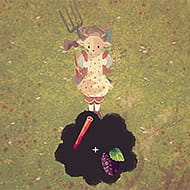
Each investigation runs on magical cards, and each card asks a specific question about where the current target might be hiding. Playing the right sequence narrows the map down until only one location remains, but the hand dealt at the start of a mission is fixed, not chosen freely.
- Review the full hand before playing a single card, since order affects how much each answer narrows the search
- Prioritize cards that eliminate large sections of Carrister Valley over ones that confirm small details
- Track answers mentally rather than relying on the map alone, since some questions overlap in what they reveal
This is easily the most discussed design choice among players, since a weak hand can turn a promising lead cold fast, and there is no way to reshuffle mid-mission. Some players find that tension the whole point of the card-driven investigation, while others have said it makes an otherwise tense hunt feel arbitrary when the cards simply do not cooperate.
A New Monster for Every Mission
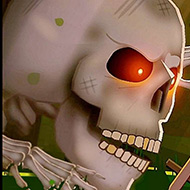
Every mission in Feed The Pit introduces a different monster acting as that day’s central threat, and its behavior is never explained upfront. Learning how each one moves, hunts, and reacts to noise is left entirely to observation, which means early encounters with a new monster almost always cost the player something before a pattern becomes clear.
Horror-focused players tend to treat this as the real draw of the game, since the fixed card investigation becomes a framework for a genuinely different survival puzzle every time the day’s threat changes.
Players more invested in the mystery side of the game sometimes find the monster encounters more of an interruption to the card-driven detective work than a highlight in their own right, and that split in what people are actually here for shows up regularly in discussion.
Life Inside Carrister Valley
The forest surrounding Carrister Valley is rendered with a retro, pixel-influenced style that leans into first-person survival horror rather than modern high-fidelity dread. That choice keeps the focus on sound and suggestion, letting the mystery of each monster’s behavior do more work than detailed visuals would.
By the time a player reaches their third or fourth investigation, the pattern of card play, exploration, and monster avoidance has usually clicked into something closer to a rhythm than a series of one-off puzzles.
Serving THE PIT and the Chosen Circle
The lore underpinning Feed The Pit, THE PIT itself, the Chosen Circle, and the vague promise of a new world order, gives the missions a reason to exist beyond their mechanics. It is played with enough dark humor that the cult trappings never feel like they are asking to be taken entirely seriously, which is part of why the tone lands as story-rich rather than grim for its own sake.
Players chasing every achievement, of which there are 14, tend to be the ones most invested in following that lore thread across multiple investigations rather than treating each mission as a standalone puzzle.
What Players Ask About Feed The Pit
- Is Act 1 the complete game? Act 1 is available now and playable start to finish, but Acts 2 and 3 are planned as free updates rather than paid expansions, so the story is intentionally unfinished at this stage.
- Does every mission have a different monster? Yes. Each mission is built around a new monster acting as that day’s central threat, with no repeated encounters carrying over identical behavior from a previous mission.
- Are there multiple endings? The game is built around branching outcomes, and how an investigation is handled, which cards are played and how encounters with that mission’s monster are managed, feeds into which ending a run reaches.
Feed The Pit succeeds by trusting a genuinely limited toolset, a fixed hand of cards and an unfamiliar monster every mission, to carry an entire investigation, and with roughly 97 percent of user reviews currently positive, the gamble of asking players to work with what THE PIT gives them seems to be paying off.