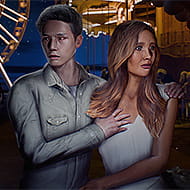
In The Stalked 3, you start the night believing you’re sneaking into an empty amusement park for a bit of harmless fun with your boyfriend, and that false sense of control matters — because everything the game does afterward is built to slowly take it away from you.
Kate — Wait, Olivia’s Ordinary Night Before Everything Changes
The setup is deliberately mundane. Jack suggests hopping the fence into Creepwood Wonderland Carnival after closing hours, and the pitch is simple enough: an empty theme park, just the two of you, no crowds. Olivia hesitates but agrees anyway, and the game spends its first stretch letting that decision feel low-stakes, almost romantic, before the first distant footstep arrives and quietly recontextualizes everything.
This slow-burn opening is one of the more debated design choices among players. Some find it essential — a necessary contrast that makes the later dread land harder. Others feel the game holds off too long before anything actually happens, and there are honestly fair points on both sides of that argument within the community.
Reading the Environment Instead of Waiting for a Jump-Scare
Unlike horror games that telegraph danger through music stings, The Stalked 3 leans on environmental storytelling players have to notice themselves. A door left slightly ajar that wasn’t before. A carnival ride that seems to be running with no one operating it. These details accumulate rather than announce themselves, and missing them is usually what leads to a player wandering straight into the stalker without realizing how close it already was.
Sound design carries most of this weight. Footsteps in the game are directional and distance-based, meaning a careful player can often tell roughly where the threat is without ever seeing it, while a player rushing through the convenience store or apartment sections tends to miss those audio cues entirely and gets caught off guard as a result.
One detail longtime fans of the developer’s earlier work bring up constantly is how the tension cuts differently here than in a typical jump-scare-driven game — the scares in The Stalked 3 tend to land in the quiet aftermath of a close call rather than during the chase itself, which several players describe as more unsettling precisely because it lingers.
NPC Conversations and What They Actually Reveal
Jack isn’t a static companion sitting in a menu somewhere. You can call him, text him, and have full one-on-one conversations that shift in tone as the night worsens, and his voice performance in particular gets singled out repeatedly in player discussions as one of the most memorable elements of the entire game. Other NPCs scattered through the convenience store and surrounding areas offer smaller exchanges, but Jack’s calls function almost like a pressure gauge for how badly things are going.
Ignoring these conversations is a common beginner mistake. New players treat the phone as flavor text and rush past it, missing context that occasionally hints at what’s coming or where a safer route might be, which becomes especially costly once you reach the carnival’s larger, more disorienting sections later in the game.
- Move slowly and listen before committing to a direction
- Treat every phone call or text from Jack as information, not just dialogue
- Pay attention to environmental changes rather than waiting for a musical cue
- Avoid the first hiding spot you see near an entrance — it’s rarely the safest
Does The Stalked 3 have multiple endings?
The full game is structured around Olivia’s escalating night at the carnival, and player discussions suggest the outcome can shift based on choices made during her conversations with Jack, though the core horror sequence remains largely fixed.
How does the demo differ from the full release?
The demo covers roughly twenty minutes centered on the uneasy opening stretch inside the carnival, while the full version extends through the apartment and convenience store sections and runs close to an hour in total.
Is the stalker always the same threat throughout the game?
Yes, but its behavior isn’t scripted — it adapts to noise and player movement, so the same threat can feel completely different depending on how carefully or carelessly you’ve been playing.
Whatever ending a particular playthrough of The Stalked 3 leads to, the image most players walk away remembering isn’t a jump-scare but the quiet dread of standing still in the Creepwood Wonderland Carnival, waiting to see if the footsteps circling somewhere nearby are getting closer or finally moving away.