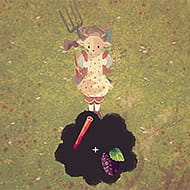
In The Garden Path you start with a hatchet, a thermos of tea, and a torn page from a journal, which is about all the guidance you get before the entire overgrown garden opens up in front of you. No objective marker tells you what to do next — you’re simply left to wander, and that’s exactly how the game wants it.
| Genre |
Slice-of-Life Gardening Sim |
| Session Length |
10 – 30 minutes daily |
| World Size |
15 acres |
| Time System |
28 real-world days per in-game year |
Reading a Garden That Doesn’t Explain Itself
The Garden Path deliberately withholds instruction. You’ll interact with a weathered stone statue near a shrine, pick up scattered materials, and have no immediate sense of what any of it is for. That ambiguity is intentional, and it’s the first thing new players need to make peace with.
Beginners commonly get frustrated trying to optimize a system that hasn’t revealed itself yet, when the better approach is simply following the map south and letting quests introduce mechanics naturally. Augustus is usually the first traveler you meet, and his request to track down the lost half of a pair of secateurs quietly teaches you how quests work before you’ve even noticed you’re being taught.
Once you’ve returned the secateurs and handed over ten sprigs of bracken, Augustus opens up trading, and shortly after, Thom appears with a trowel and a lesson in planting seeds. The game’s pacing is built entirely around these small, sequential reveals rather than a tutorial dumping every system on you at once.
Dust Flies, Guide Stones, and the Garden’s Quiet Hint System
Once harvesting tools are unlocked, distinguishing plants from each other becomes its own small puzzle, and that’s where dust flies come in — flitting toward the correct plant when you’re struggling to tell one sprig from another. It’s a subtle system, easy to miss if you’re not paying attention to movement at the edge of the screen.
Guide stone fragments serve a similar purpose on a larger scale, appearing as small rewards whenever you stumble onto something new, like discovering how to plant seeds for the first time. Collecting enough of them slowly builds out a picture of what the garden actually contains.
Players who lean into exploration tend to find these systems naturally, wandering into new mechanics simply by poking around every corner of the map’s fifteen acres. Players who prefer structure sometimes find the lack of explicit direction frustrating at first, and that split in preference is one of the most common threads in discussions about the game.
Larto, Tabbal, and the Cast Worth Returning For
Beyond Augustus and Thom, The Garden Path fills its map with travelers who each bring their own small storylines. Larto, a musk ox with a fondness for song-fish, spends his time fishing near the river and hands you a rod once you’ve earned his trust — from there, whistling to charm song-fish in the fishing minigame becomes one of the more meditative loops in the game.
Tabbal, a grumpy Berber toad, only shows up on rainy days, which means players chasing a full roster of companions have learned to check the weather before assuming a character simply isn’t available yet. It’s the kind of detail that only becomes obvious after enough real-world days spent returning to the garden.
Completing small tasks — picking ten flowers, pitching a tent — earns stars that form constellations, and filling a constellation is what ultimately convinces a new traveler to settle in the garden permanently. It’s a slow process by design, and players focused on collecting the full cast talk about it as a long-term project rather than something to rush.
What a Full Year in the Garden Actually Looks Like
Time in The Garden Path moves on a real-world schedule — twenty-eight real days make up one full in-game year, split across all four seasons, with each in-game day mirroring a real 24-hour clock. That means the garden keeps changing whether you’re actively playing or not, and returning after a break often means noticing growth or decay you weren’t there for.
This pacing is also where the game divides players most sharply. Some find the daily-return rhythm relaxing, a reason to check in briefly rather than commit to long sessions. Others find the slow payoff genuinely difficult to stick with, especially early on when the garden hasn’t opened up enough to reward a quick visit.
By the time you reach later seasons, once Myrtle has grown enough to yield cloves and your stash near the shrine is full of traded goods, the daily rhythm starts to feel less like waiting and more like tending something that’s actually yours.
An Honest Look at the Garden’s Rough Edges
Not everything about The Garden Path runs smoothly, and players have been upfront about it in community discussions. Inventory issues around composting weeds and stacking harvested seeds have frustrated more than a few people trying to keep their storage manageable, and lost stash items tied to quest progress have occasionally blocked players from finishing what Thom asked of them.
None of that undoes what the game does well, but it’s worth going in knowing the experience isn’t entirely frictionless. The developer has continued patching these kinds of issues, and the community around the game tends to be patient about it given how much charm the rest of the experience carries.
How long is a full year in The Garden Path?
One in-game year runs across twenty-eight real-world days, cycling through all four seasons while each individual in-game day still mirrors a normal 24-hour clock.
How do you get new characters to move into the garden?
Completing small tasks like picking ten flowers or pitching a tent earns stars, and once enough stars form a complete constellation, a new traveler decides to settle permanently in the garden.
What are the journal pages used for?
Scattered journal pages piece together the garden’s hidden history, and collecting a full set — ten pages, in Thom’s case — is tied directly to unlocking more of that backstory through him.
The Garden Path asks for patience in a way few slice-of-life games do, trading instant gratification for a garden that genuinely feels earned over real weeks of returning to it. Between Augustus’s early quests, Larto’s quiet riverside fishing, and the slow reveal of Myrtle’s harvest, it’s a game built for people willing to let a story unfold at its own pace rather than rushing toward the end.