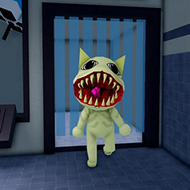
In Five Nights In Anime Remastered you start with nothing but a flashlight and a short list of objects to find on the first floor of a house that already knows you’re inside it, and that opening condition matters more than it sounds like it should. Every floor after this one builds directly off the habits you form during those first few minutes: how you use light, how you listen, and how quickly you learn to stop walking in a straight line toward danger.
Starting the Story in Five Nights In Anime Remastered
The campaign is broken into distinct locations rather than a single repeated room, which sets it apart from most animatronic horror games built around sitting still behind a desk. You move through a First Floor, a Basement, an Attic, and eventually a Forest, and each location introduces its own stalking animatronic along with its own win condition.
There’s no camera bank to flip through here. Instead, Five Nights In Anime Remastered puts you inside the house itself, letting you walk between rooms, open doors, and physically avoid whatever is hunting you on that floor.
That open, walk-anywhere structure is the first thing longtime fans of office-based horror games notice, and it changes how tension builds. You can’t just watch a monitor and wait; you have to keep moving and keep choosing where to go next.
Ignited Freddy and the First Floor
The First Floor introduces Ignited Freddy, and the objective here is straightforward on paper: collect a set number of objects scattered around the floor before time runs out. In practice, doing it while Freddy is actively hunting for you is a different problem entirely.
Freddy’s presence on this floor functions as an introduction to the game’s core loop, teaching new players to check corners and doorways before committing to a room. Rushing through the First Floor without learning that habit tends to get players killed almost immediately once they hit the Basement.
Early in the game, players usually treat Freddy as the easy one, and by most accounts he is, which makes him a useful benchmark for how the difficulty ramps up floor by floor.
Ignited Bonnie’s Basement Chase
The Basement is where Five Nights In Anime Remastered starts to feel genuinely dangerous. Players have to collect five objects in sixty seconds while Ignited Bonnie roams the space, and once Bonnie locks onto you and starts chasing, the only real option is to run.
Bonnie’s chase is notorious in player discussions for how relentless it feels. He doesn’t tire, doesn’t lose interest, and doesn’t give you the breathing room that Freddy does on the floor above, which is exactly why so many players cite the Basement as the point where the game stops being approachable and starts being punishing.
That sixty-second window is tight enough that most players fail it at least once before working out an efficient route between objects.
Ignited Foxy in the Attic
The Attic raises the object count and the clock, asking for five items in ninety seconds, with Ignited Foxy stalking the space before breaking into a sprint. Once Foxy starts running at you, shining the flashlight directly on him is what stuns him and buys a few more seconds to keep collecting.
The timing on that flashlight cue is unforgiving. Miss the window and Foxy closes the distance fast enough that there’s rarely a second chance to react.
Players who’ve cleared the Attic a few times start treating the flashlight less like a tool for seeing and more like a weapon they have to aim under pressure, which is a mental shift the earlier floors don’t really demand.
Ignited Chica and the Forest
The Forest section changes the objective again, sending players after ten drawings scattered across the area within a five-minute window while Ignited Chica stalks nearby. Her mechanic flips the usual instinct: looking directly at Chica is what stops her from closing in, but staring too long gets you killed instead.
- Ten drawings to find across the Forest within the time limit
- Looking at Chica halts her approach
- Holding that look too long triggers her attack instead
Balancing those two opposite instincts, look but don’t look too long, is what makes the Forest one of the sections players argue about most when comparing which floor is the hardest in Five Nights In Anime Remastered.
The five-minute clock feels generous compared to the Basement’s sixty seconds, but Chica’s stare mechanic makes up the difference by demanding constant attention instead of a fast route.
Springtrap and the Ending
After the earlier floors, the story pushes toward a finale involving Springtrap, arriving once the location has been set ablaze and the player has to navigate through the burning remains. Springtrap survives the fire, and the confrontation that follows is framed as inevitable rather than something you out-skill.
Reaching this point after clearing Freddy, Bonnie, Foxy, and Chica gives the ending real weight, since the four floors leading up to it each taught a slightly different survival skill that the finale doesn’t bother reintroducing.
It’s a grim capstone, and some players find the lack of a clean escape unsatisfying compared to endings in other animatronic horror games, while others think it fits the tone the rest of the campaign already set.
Roaming and Survival Mode in Five Nights In Anime Remastered
Outside the story sections, the survival mode drops the fixed objectives and just asks you to last as long as possible while exploring and scavenging items. The Ignited animatronics get more aggressive as the timer climbs, which forces players to keep circulating instead of camping in one safe-feeling room.
Doors can be opened and closed to control which routes stay available, and turning on electronics like a radio in one room can pull an animatronic’s attention away from wherever you actually need to go.
Survival mode is where a lot of the community’s favorite moments come from, since the open, unscripted layout means no two close calls play out quite the same way twice.
Flashlight, Doors, and Sound as Tools
Every tool in Five Nights In Anime Remastered does double duty. The flashlight reveals what’s in a dark room, but it’s also what forces an approaching animatronic to back off or, in Foxy’s case, stuns him outright.
Doors aren’t just obstacles between rooms; closing one behind you buys a few seconds, while leaving one open can bait an animatronic down a path you’d rather they take. Sound works the same way in reverse, distracting rather than blocking.
Once you understand that every object serves at least two purposes, the game reads less like a checklist of fetch objectives and more like a set of tools you’re expected to combine on the fly.
- How do you survive Ignited Bonnie in the Basement? Running the moment he starts chasing is the only reliable answer, since his pursuit doesn’t let up once it starts, and most players learn the object layout well enough to grab all five items before he locks on in the first place.
- What happens when Ignited Chica catches you in the Forest? Looking away or holding eye contact too long both end badly, since Chica closes in if you stop watching her and attacks if you stare past the safe window, so the trick is timing short glances rather than a constant stare.
- Is Springtrap the final threat in the story mode? Yes, Springtrap appears after the earlier floors are cleared and the location burns, and the confrontation that follows caps the campaign rather than opening into another chase.
Five Nights In Anime Remastered earns its reputation the hard way, floor by floor, forcing players to learn Freddy’s patience, Bonnie’s relentless chase, Foxy’s flashlight timing, and Chica’s uncomfortable stare-down before ever reaching Springtrap. By the time the fire in the finale dies down, the game has made its point: walking a haunted house on your own two feet is a very different kind of dread than watching a monitor from behind a desk.