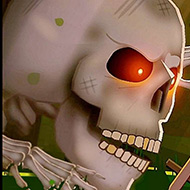
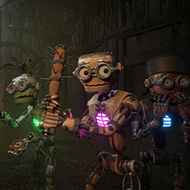
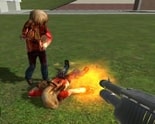
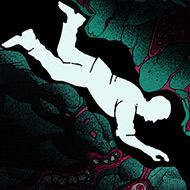
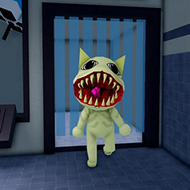
What actually happens when your vessel breaks halfway through a run in GRAIN ROT? It’s the question new players ask the moment they realize dying doesn’t mean watching their friends finish the raid without them. Your Living Spark survives the wreck, drifts free of the splintered wood, and goes looking for a new body — which is either the smartest design decision in recent co-op horror or the reason your teammates keep stealing your legs, depending on how the run is going.
| Genre |
Co-op extraction horror, builder |
| Modes |
Solo, 1-4 player online co-op |
| Player Character |
A Living Spark, piloting wooden vessels |
| Setting |
A scorched wasteland and its shifting underground ruins |
Descending Into GRAIN ROT’s Shifting Ruins
Every run starts the same way: your crew rides a cursed elevator down from the Sanctuary Outpost into ruins that rearrange themselves between visits. Nothing about the layout is memorized permanently, which is deliberate — the game wants each descent to feel unfamiliar even once you know the general shape of a biome.
Early on, most crews get this wrong by treating the first floor like a tutorial they can coast through. It isn’t. The Corrupted start showing up almost immediately, and players who rush ahead without checking corners tend to lose their vessel before they’ve even found anything worth extracting.
Living as a Spark Instead of a Body
The core idea that separates GRAIN ROT from most extraction games is that death isn’t really death. Your vessel can splinter, get smashed, or catch fire, but the Living Spark inside survives and can possess a new body somewhere in the ruins. That single mechanic changes how failure feels — instead of spectating while your team finishes without you, you’re scrambling to find an empty vessel and get back into the fight.
Community shorthand for this moment is simply “going Spark,” and it comes up constantly in run recaps because it’s the difference between a bad death and a genuinely bad run. Lose every vessel on your team at once and everything you were carrying is gone for good.
Grappler, Hauler, Ghost, and Sacrifice Vessel Builds
Not every wooden body plays the same. The community has settled on four rough archetypes for how vessels get used: the anchor build that holds doorways and chokepoints, the hauler build that maximizes carry capacity for Grinder runs, a faster scouting build, and a tankier frame meant to buy the crew time in the deepest layers. None of this is officially labeled in-game, but it’s how most crews talk strategy before a descent.
What beginners consistently get wrong is possessing whatever vessel is closest instead of matching a body to the run’s goal. A crew hauling furniture out of a loot-heavy floor doesn’t want their best carrier stuck holding a doorway, and a crew fighting through a Corrupted-dense stretch doesn’t want their tankiest vessel three rooms away scavenging.
Smashing Furniture and Feeding the Grinder
Furniture in GRAIN ROT isn’t set dressing. It’s loot, cover, and building material depending on what your crew needs in the moment. Smash a wardrobe for quick debris, feed it into the Grinder for instant gold, or leave it standing between you and something chasing you.
That constant decision is the game’s real economy tension. Gold funds Outpost upgrades back home, but furniture also gets hauled back whole to fund construction, so grinding everything on sight for fast cash quietly starves your base upgrades later. Veteran crews describe this as the moment GRAIN ROT stops feeling like a horror game and starts feeling like a resource-management puzzle with monsters attached.
Biggie, Murch, and the Sanctuary Outpost
Every run begins and ends at the Sanctuary Outpost, a crumbling high-rise held together by two brothers, Biggie and Murch. Between raids, this is where gold and salvage actually turn into permanent progress — unlocking new vessels, upgrading rooms, and expanding what your crew can survive on the next descent.
By the time a crew has cleared a handful of runs, the Outpost stops feeling optional. Skipping upgrades to rush back into the ruins usually means dying to something a stronger vessel or a better tool would have handled easily.
How Difficulty Escalates the Deeper You Go
The scorched wasteland above ground is only the entry point. The deeper layers beneath the ruins are where GRAIN ROT gets genuinely unsettling — sound distorts, bodies pick up visible corruption, and something as small as an emote can turn unnerving without warning. It’s not a difficulty curve built purely on tougher enemies, it’s one built on making the game itself feel less trustworthy the further down you push.
Players chasing the best loot inevitably end up debating exactly how deep is too deep for a given crew size, and there’s no clean answer. A four-player crew with strong Grinder routing can push further than most solo runs would ever attempt safely.
Where the Comedy and the Horror Collide
What makes GRAIN ROT stand out in a crowded field of co-op extraction games is how openly it embraces its own physics comedy alongside genuine dread. One moment your crew is carefully clearing a room of Corrupted; thirty seconds later someone has dropkicked a teammate into a monster because it seemed funny at the time. Both halves of that are intentional, and reviewers and players alike keep pointing to it as the game’s defining texture — surviving your teammates is treated as seriously as surviving the Rot itself.
It’s also the game’s most divisive trait. Some players find the constant physics chaos undercuts the horror atmosphere the ruins are working to build; others think that friction is the entire appeal, and that a purely serious version of this loop would get old within a handful of runs. What can you actually recover if your whole crew breaks on the same run, and is it worth pushing one floor deeper for it? The honest answer from most veteran crews is that it depends entirely on how much Outpost progress you’re willing to gamble, since a wiped run means every vessel’s carried loot is gone for good, not just delayed.
Between the Grinder economy, the Spark-possession loop, and Biggie and Murch bickering over the Outpost between runs, GRAIN ROT builds a specific kind of dread that’s just as much about your own crew’s decisions as it is about whatever’s waiting in the Deep Layers.