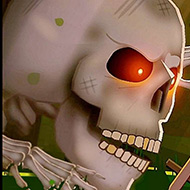
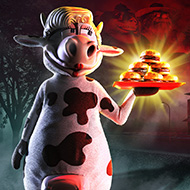
What happens when the grill timer runs out and Asset Joy is already standing behind you? That’s the exact question Happy’s Humble Burger Farm keeps asking, over and over, disguised as a cooking shift that never quite ends. The game hands you a uniform, a register, and a night-shift job at a fast-food restaurant tucked somewhere between a haunted wood and a city that doesn’t want to explain itself.
| Genre |
Horror Cooking Simulation |
| Platform |
PC, PlayStation, Xbox, Nintendo Switch |
| Setting |
New Elysian City |
| Core Mechanic |
Cook and deliver orders while avoiding hostile mascots |
| Structure |
Repeating day cycle: work, apartment, sleep |
The Loop That Happy’s Humble Burger Farm Never Explains
You wake up, you go to your shift, you come home, and you sleep, only to do it again the next day. There’s no cutscene walking you through why this cycle exists, and that silence is deliberate. Early on, most players assume the loop is just structural padding, a way to string minigame shifts together, but the repetition itself becomes part of the horror once small details in the apartment or the restaurant start shifting between days.
Your best friend Toe shows up periodically, and his blank-faced design scares plenty of first-time players before they realize he’s harmless. That misdirection is common throughout the game.
New players almost always underestimate how much information is hidden outside the shift itself, tucked into notes, boom-box cameos, and background details you’d otherwise walk past.
It rewards attention more than reflexes at first.
Cooking Under Pressure at Happy’s Humble Burger Farm
- Grab the correct meat and cook it to the order’s specification without burning it
- Assemble the burger in the right sequence and add any requested toppings
- Deliver the completed order to the customer before the timer runs out
The actual cooking loop is simple by design: get the meat, build the burger correctly, and get it to the counter before your customer loses patience. What complicates things is that every ingredient needed for a recipe can be found somewhere in the open world, which means players who explore thoroughly during downtime have a real advantage during rushes.
Speedrunners and completionists treat the cooking segments completely differently. One group is optimizing every second of the shift timer, while the other is more interested in what’s hiding behind the counter once the last order is cleared.
Burgers double as weapons later on, which surprises most players the first time they’re forced to throw one at something chasing them instead of serving it.
Asset Joy and the Threat Behind the Counter
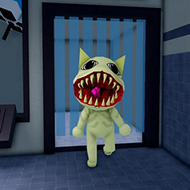
Infractions on shift carry real consequences, and repeated mistakes risk drawing out Asset Joy, the restaurant’s mascot-turned-threat who chases you down if you slip up too often. Unlike a scripted jump scare, Asset Joy’s appearances are tied directly to your performance, which makes every burnt patty feel like it actually matters instead of just costing points.
The eerie, motionless mascots scattered around the restaurant floor are unsettling specifically because most of them never move at all, and the few that do are never the ones you expect.
Horror-focused players tend to describe this as the game’s strongest trick: dread built from stillness rather than constant chase sequences.
The Farm Sequence and Its Own Set of Rules
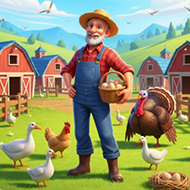
Partway through, a hallucination drops you straight into a farm setting where a farmer wielding a scythe attacks on sight. The only way through is plating three distinct types of hamburgers using ingredients scattered across the farm and feeding them to the farmer until the encounter dissolves. It’s one of the clearest breaks from the restaurant’s usual rhythm, and it catches almost everyone off guard the first time it happens.
Story-hunters treat this sequence as one of the biggest lore drops in the entire game, since it ties directly into the farm-themed mascots referenced throughout the restaurant’s decor.
By the time you reach this sequence, the line between “cooking sim” and “survival horror” has essentially dissolved.
What Happy’s Humble Burger Farm Borrows and What It Doesn’t
Comparisons to Overcooked! come up constantly because of the frantic order-based cooking, and comparisons to mascot-horror games are just as common given the unmoving animatronic-style cast. What sets it apart is how much of the horror lives in the apartment and the city between shifts rather than exclusively at the restaurant, which is a structural choice a lot of similar games skip entirely.
Some players find the controls stiff, especially during the more frantic cooking segments, and that criticism shows up often enough in community discussions to be worth acknowledging rather than glossing over.
Others argue the stiffness actually adds tension, since fumbling an input under pressure feels closer to panic than precision.
Why does the day-to-day loop in Happy’s Humble Burger Farm never seem to end?
The repeating cycle of work, home, and sleep is intentional rather than a technical limitation, and it exists to make small environmental changes between days feel unsettling once players start noticing them.
What triggers Asset Joy to appear during a shift? Asset Joy responds directly to mistakes made during cooking, meaning repeated burnt orders or missed deliveries increase the odds of being chased rather than any scripted timer.
What is the farm sequence in Happy’s Humble Burger Farm, and how do you survive it?
The farm sequence is a hallucinated detour where a scythe-wielding farmer attacks the player, and the only way out is cooking three specific hamburger types and feeding them to the farmer until it stops.
Between Toe’s unnerving cameo, Asset Joy’s escalating pursuit, and a farmer who only wants the right burger, Happy’s Humble Burger Farm turns a fast-food shift into something closer to a fever dream, and it never once explains itself outright. That refusal to hand-hold is exactly why players keep returning to their apartment each night, half expecting the loop to finally break.