You drag one shape across a black-and-white scene, overlap it against another, and the answer to the puzzle simply appears — not because a timer ran out or a hint button was pressed, but because the two pieces finally sat in the right relationship to each other. That quiet click of recognition is the entire currency Her Trees: Puzzle Dream trades in, across more than forty puzzles built around exactly that feeling.
Solving Puzzles Through Overlap, Not Calculation
The mechanic driving every puzzle here is deceptively simple to describe: move objects around a scene, overlap them, and combine them until the correct configuration produces the intended result. There’s no arithmetic hiding underneath any of it and no hidden numerical system to reverse-engineer — the game leans entirely on observation, spatial reasoning, and intuition instead of the kind of logic-gate puzzles that ask a player to calculate their way to an answer.
That design choice shapes the whole pace of a session. Puzzles here reward sitting with a scene and noticing how its pieces relate to each other, rather than working through a checklist of rules the way a more mechanical puzzle game might demand. It’s a deliberately unhurried kind of problem-solving, and the game’s own hint system reflects that pacing — hints and solutions only become available after a player has spent a meaningful stretch of time on a given puzzle, rather than being offered immediately on request.
Her Trees: Puzzle Dream is the third entry in its series, but it’s built to stand on its own. Nothing about the puzzle logic assumes familiarity with earlier entries, and the black-and-white, low-text presentation means a newcomer isn’t missing context by skipping straight to this one.
A Monochrome, Nearly Silent Art Style
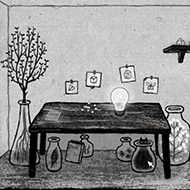
Visually, the whole game commits to a hand-drawn, black-and-white aesthetic, which does double duty as both an artistic choice and an accessibility one — the monochrome presentation means color-blind players aren’t at any disadvantage working through its puzzles, since color was never part of the solving logic to begin with.
The game also keeps text to a minimum throughout, relying on its dreamlike, surreal visual language to communicate what a puzzle wants rather than written instructions. Combined with calm background music, the overall tone leans toward something closer to a relaxed, atmospheric experience than a game trying to create tension or urgency around its puzzles.
That combination of sparse text and monochrome art gives the whole thing a consistent, slightly eerie dream logic — objects and scenes don’t always behave the way real-world physics would suggest, which is part of what makes puzzling out the “right” overlap feel more like following an intuition than solving a formula.
A Short Sitting Built Around More Than Forty Puzzles
A full playthrough runs somewhere between an hour and a half and three hours, which places it firmly in the range of a single relaxed sitting rather than a sprawling campaign. Across that time, the game moves through more than forty individual puzzles, each one built around its own specific overlap or combination rather than reusing the same trick repeatedly.
- Do you need to have played the earlier HER TREES games first? No — this is the third entry in the series, but it’s specifically designed to be approachable as a standalone experience for newcomers.
- How many puzzles does the game include? More than forty, each built around moving, overlapping, or combining objects rather than a calculation-based challenge.
- Is the game accessible to color-blind players? Yes — the entire presentation is monochrome, so no puzzle logic in Her Trees: Puzzle Dream depends on distinguishing between colors.
A Small Game Built for a Very Wide Audience
Despite its quiet, niche presentation, Her Trees: Puzzle Dream ships with support for 103 languages, which is an unusually wide localization footprint for a puzzle game this size — though the low-text design likely made that breadth easier to manage than it would be for a script-heavy game. A downloadable demo is also available separately from the full release, letting players get a feel for the overlap-and-combine mechanic before committing to the complete set of puzzles.
Reviews for the full release have been strongly positive, sitting in the high-90s percent range across well over a thousand reviews, with recent reception holding at a similarly high level rather than dropping off after launch.
The price sits well below most full-priced puzzle releases, and it’s also sold bundled together with an earlier entry in the series for players who want to start from the beginning of the continuity rather than jumping straight into the third game.
Why the Pacing Feels Different From Most Puzzle Games
Plenty of puzzle games measure success by speed — a leaderboard, a timer, a par count to beat. Her Trees: Puzzle Dream doesn’t build any of that pressure into its structure. The delayed hint system alone signals what kind of experience it’s aiming for: one where getting stuck on a puzzle for a while is treated as part of the intended pace rather than a failure state to be rescued from immediately.
That unhurried design is also why the game gets described repeatedly as cozy and atmospheric rather than challenging in a punishing sense. The puzzles can genuinely stump a player, but the surrounding presentation — the quiet music, the patient hint system, the lack of any visible failure state — keeps the overall experience feeling closer to a calm exploration than a test.
Between the delayed hints, the monochrome art, and the calm pacing that never once rushes a player toward an answer, Her Trees: Puzzle Dream never asks a player to do math or memorize a rulebook — it just asks them to look closely at a black-and-white scene until two shapes finally overlap the way the puzzle always intended, and across more than forty of those small, quiet realizations, that’s the entire game.