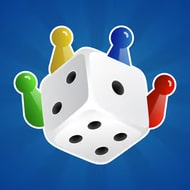
In Ludo Hero you start with all four of your tokens locked inside your home base, unable to move until a six turns up on the die, and that single restriction shapes almost every early decision in a match. Waiting on a six sounds trivial, but with four players all doing the same thing, a slow start can mean watching three opponents build a lead before a single token of yours has even left home.
Four Tokens, One Home Base, and the Six You Need to Start
Every player begins with four tokens tucked inside a colored home base, and none of them so much as touch the main track until the die shows a six. This starting condition is standard across virtually every version of Ludo, and Ludo Hero keeps it intact rather than smoothing it over with a softer rule. The die itself is a plain six-sided cube, so on any given roll there’s roughly a one-in-six chance of landing the number needed to make a move that actually matters.
Two to four people can sit down for a match, and any empty seat can be filled with a computer-controlled opponent instead of leaving a spot unplayed. That flexibility matters whether it’s three siblings squeezing in a fast round or a stricter four-player match, because Ludo’s whole rhythm depends on having enough tokens circulating around the board to make the safe spots and capture mechanic actually relevant.
Rolling a Six in Ludo Hero: Extra Tokens or Extra Distance
Once at least one token is already out, rolling a six stops being just the entry key and becomes a real choice: move an existing token six spaces forward, or spend the roll releasing another token from home instead. This is where Ludo Hero rewards a bit of forward planning rather than pure reflexes, since committing every six to fresh tokens can leave an early mover stranded too far behind to reach any safe spot in time.
Rolling anything from one through five just moves a token that number of spaces along the track, with no special effect attached.
Star-Marked Safe Spots and Getting Sent Back to Start
The board includes a handful of squares marked with a star, and any token sitting on one of these cannot be captured no matter what an opponent rolls. Land on an unmarked square that an opposing token already occupies, though, and that token gets knocked all the way back to its home base to start its lap over again. For anyone playing casually with kids, the star squares are usually the first rule everyone remembers, since getting captured feels unfair without them. A few real rules worth keeping straight:
- Star-marked squares protect any token sitting on them, no matter which color it belongs to.
- Landing exactly on an opponent’s token outside a star square sends it straight back to its home base.
- The square just outside each color’s home triangle entrance also counts as protected.
Losing a token that’s traveled three-quarters of the way around the board to a single unlucky roll is the most frustrating moment in a match, and it’s also the moment that turns a casual family round into a much tenser one.
Some traditional Ludo rulesets also let two tokens of the same color occupy one square to form a block that opposing tokens can’t pass or land on, though not every digital version implements this the same way, so it’s worth watching how a given match actually behaves rather than assuming the physical-board rule carries over exactly.
The Exact Roll Ludo Hero Demands to Reach the Home Triangle
Getting a token all the way around the track is only half the job. To actually finish, a token has to enter the home triangle with an exact roll — overshoot the final square even by one pip and the token just sits still for that turn. This exact-count rule is one of the more commonly misunderstood parts of Ludo Hero for anyone coming from board games where reaching the end is enough regardless of what the die shows.
It also slows the endgame down considerably. A player can have three tokens already home and one token camped just outside the triangle for several turns running, rolling number after number that’s simply too big to use.
Where Luck Ends and Strategy Begins
Ludo is, by its own community’s admission, a game that leans heavily on the dice. Plenty of players describe entire matches decided by who rolls sixes at the right moment rather than by any real decision made at the board. That said, Ludo Hero still leaves room for genuine choices: which of two vulnerable tokens to move when only one can reach a star-marked square, whether to gang up on whoever’s currently in the lead, and when to hold a token back near home instead of exposing it on an open stretch of track.
Competitive players tend to keep tokens paired near safe spots and avoid spreading all four out early, while more casual players — especially younger or newer ones — often rush every token onto the board the instant a six appears, which is usually the mistake that costs them a token to a capture a few turns later.
The debate over how much of Ludo Hero comes down to skill versus dice luck isn’t new. It’s the same argument that’s followed the Pachisi family of games since Ludo was patented in England back in 1896, and it’s unlikely to get settled at any table anytime soon.
Getting All Four Tokens Home in Ludo Hero
The finish line isn’t just one token reaching the triangle — a player only wins once all four of their tokens have made it home with an exact roll each. That requirement is part of why the endgame stretches on longer than newer players expect; three tokens sitting safely home means nothing if the fourth is stuck circling the last stretch of track waiting for the right number.
Because a match with computer-controlled seats keeps going after the first player finishes, second, third, and even last place still get decided the same way, which gives a losing position something to play for instead of the match simply ending the moment the leader gets home.
Ludo Hero doesn’t try to disguise how much of the outcome rides on the die. But between the star-marked safe spots, the choice of whether to spend a six on a new token or an old one, and the exact roll needed to close out the home triangle, there’s enough real decision-making squeezed into those rolls to keep four players arguing about strategy long after the last token comes home.