In Universe Sandbox 2 you start with a bare planet hanging in empty space and an entire panel of weapons you haven’t touched yet, and that blank-slate setup matters more than it sounds like it should. There’s no health bar to manage, no enemy waiting to react, just a voxel-built world and every tool needed to take it apart piece by piece, at whatever pace you choose.
| Genre |
Planet destruction sandbox simulation |
| Main Modes |
Planet Smash and System Smash |
| Weapon Count |
More than 30 distinct tools, several customizable |
| Core Mechanic |
Apply weapons and forces to voxel-based planets |
| Session Style |
Open-ended, no fixed win condition |
Two Ways to Play Universe Sandbox 2
The game splits cleanly into two modes. Planet Smash puts a single world in front of you and hands over the full weapon panel, while System Smash zooms out to whole star systems, letting you drag planets, watch orbits destabilize, or slingshot one body into another and see what the resulting collision looks like.
Most first sessions happen in Planet Smash simply because it’s more immediate: pick a weapon, aim, and watch the surface react. System Smash rewards patience instead, since orbital mechanics take longer to unfold than a single explosive hit.
Switching between the two changes what kind of player you are in the moment. Planet Smash suits anyone who wants instant feedback, while System Smash appeals more to players who enjoy setting something in motion and watching consequences play out over time.
Choosing a Weapon: From Asteroids to Antimatter
The weapon roster in Universe Sandbox 2 is the main draw for a lot of players, and it’s large enough that most people never use everything on offer in a single sitting. A typical selection covers:
- Nuclear missiles that punch a deep, glowing crater into one spot
- Asteroids that slam into a targeted point with blunt, satisfying force
- Lasers that carve continuous lines across the surface instead of single impacts
- Black holes that pull mass away from the planet over time
- Antimatter missiles and railguns for players who’ve exhausted the basics
- Novelty tools like a UFO fleet or an armed space shiba for less serious runs
New players tend to gravitate toward nukes first because the feedback is immediate and dramatic, but the more interesting damage patterns usually come from combining tools rather than relying on one repeatedly.
What a Black Hole Actually Does
Dropping a black hole beside a planet in Universe Sandbox 2 doesn’t cause an instant explosion the way a nuke does. Instead it slowly siphons mass away, and watching a world lose its shape and get pulled apart over several seconds is one of those moments that’s genuinely hard to describe until you’ve seen it happen in real time.
It’s also one of the tools most likely to produce unpredictable results in System Smash, since a black hole dropped into a populated star system can drag in neighboring planets long after the player has stopped actively aiming anything.
Reading Nuclear Damage and Crater Patterns
Nukes reward a bit of technique once players move past the first few sessions. A single detonation leaves a deep crater with a lingering radiation glow, but stacking several in one hemisphere produces compounding surface damage that a lone strike never achieves.
By the time a player has gone through a dozen or so planets, the difference between a scattershot approach and a deliberately aimed cluster of nukes becomes obvious in how fast a world actually breaks apart.
System Smash and Moving Whole Solar Systems
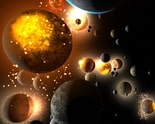
System Smash is where Universe Sandbox 2 stops being about single impacts and starts being about physics over time. Players can load a preset system, including a recognizable version of our own solar system, or build one from nothing and set orbital paths by hand.
Dropping a black hole into the middle of an active system, or using a pair of lasers to nudge a planet out of orbit, tends to produce chain reactions that are more entertaining than anything a single weapon can do on its own.
Building and Customizing Planets
The planet editor lets players adjust size, composition, and even population density before ever touching a weapon, which turns destruction into something closer to a personal experiment than a fixed challenge. Saved custom planets can be reloaded later, so a carefully built world doesn’t have to be rebuilt from scratch every session.
Exotic star system elements, like artificial ring worlds and oversized moons, give players something beyond ordinary rocky planets to test weapons against, and those tend to react differently than a standard voxel sphere does.
This customization layer is what keeps longtime players coming back after the initial novelty of nukes and lasers wears off.
Population and the Details Players Notice
Populated planets track a simulated population that reacts to damage, and watching that number drop as a crater spreads is a detail that sticks with players more than the visual explosion itself. It’s a small touch, but it’s the kind of thing that comes up constantly when players describe their first real session.
Sound design plays into this too. The dull thud of an asteroid impact reads completely differently from the sharper crack of a laser strike, and players who’ve spent time with the weapon roster can often tell which tool was used just from the audio alone.
Where Universe Sandbox 2 Gets Genuinely Deep
What looks like a simple destruction toy on the surface turns out to have real depth once orbital mechanics and mass calculations get involved. Moving a moon in System Smash affects tides and stability in ways that aren’t obvious until a player has spent real time watching a system evolve rather than just triggering one-off explosions.
Advanced players start combining tools deliberately, using a black hole to destabilize a system before finishing it off with a cluster of asteroids, which produces results neither tool manages alone.
That layered approach is where Universe Sandbox 2 separates casual players who just want to watch things blow up from the players who treat it more like a physics playground.
What Players Debate About the Weapon Roster
Not every addition lands the same way with the community. Novelty weapons like the space shiba or various celestial-being tools get plenty of use for laughs, but some longtime players feel they dilute a roster that used to lean more heavily on tools grounded in actual astrophysics. Both camps show up regularly in discussion, and neither view has really settled the argument.
Questions About Universe Sandbox 2
- What’s the fastest way to destroy a planet completely? A black hole dropped near the core tends to do the most thorough job over time, since it removes mass continuously rather than damaging one area at a time the way a nuke or asteroid does.
- Can moons and planets actually collide with each other? Yes, particularly in System Smash, where dragging one body into another or destabilizing an orbit with a black hole can send planets crashing together with visible physical consequences.
- Does population size affect how a planet reacts to damage? Population is tracked as a simulated number that drops as damage spreads, though it’s a visual and numerical detail rather than something that changes the underlying destruction mechanics.
Universe Sandbox 2 works because it never rushes the payoff: whether it’s a black hole slowly unraveling a planet or a slingshot maneuver sending a moon into open space, the game trusts players to find their own reasons to keep testing the next combination of tools.